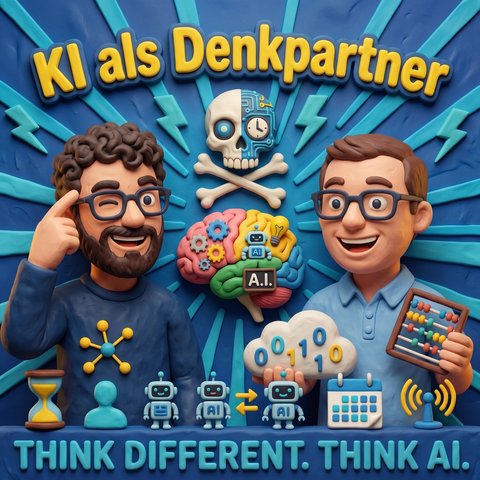
KI als Denkpartner
Auf Deutsch lesenTopics Modelle und Anbieter
What it is about
Zustimmung, Gedächtnis und Entscheidungen: Wie man KI als Gegenüber nutzt, ohne sich selbst zu bestätigen
Eine KI stimmt einem schnell zu. Das fühlt sich gut an und bringt wenig, wenn es ums Denken geht. Mark und Jens sprechen darüber, wie sie KI als Denkpartner einsetzen: als Gegenüber beim Brainstorming, als Prüfer, der Schwachstellen sucht, und als Werkzeug, das Ideen über Nacht sortiert. Am Anfang steht die Frage, warum Ideen in der Gruppe nicht gleich erstickt werden sollten, und wo der Realismus dann wieder einsetzen muss.
Der Schwerpunkt liegt auf dem Gedächtnis. Was eine KI über einen speichert, bleibt oft länger im Kopf als man selbst. Ein Kollege hat ein Dokument mit noch nicht geprüften Kennzahlen abgelegt, ein Assistent hat sie später als Ergebnis zurückgegeben, und zunächst hielt er seine eigene Prognose für bestätigt. Dazu kommen Fragen, die über den Einzelfall hinausgehen: Wer entscheidet, welches Wissen im Gedächtnis höher gewichtet wird? Wie lassen sich Entscheidungen mit Zeitpunkt und Kontext festhalten, damit eine alte Entscheidung nicht ungeprüft wiederholt wird? Und wie erkennt man, dass ein Eintrag veraltet ist?
Auch der Blick auf die eigene Arbeit gehört dazu. Wer mit KI ein Projekt bis zum Ende treibt, verliert leicht das Maß, und ein Abo oder ein Token-Kontingent wird zum Anlass, noch eine Frage zu stellen. Mark und Jens beschreiben, wie sie in Sackgassen vorgehen und warum sie einen Schlaf über Ideen für sinnvoll halten.
Transcript
00:00:00Welcome to Think Different. Think AI., the podcast with Mark and Jens.
00:00:07Two tech-obsessed minds who don't just talk about artificial intelligence, they live it.
00:00:14Here you get clear takes, real hands-on insights and a fresh look at what's possible.
00:00:20Understandable, critical and always with a wink.
00:00:24AI to think about, to smile about and above all to join the conversation.
00:00:33Welcome to Think Different. Think AI.
00:00:37We have a special episode for you today.
00:00:39As you're already hearing, we, yes, that is Jens and me.
00:00:42Hello Jens.
00:00:43Hello Mark.
00:00:45I briefly wondered whether you'd still answer
00:00:46within a reasonable second of delay.
00:00:49So the listener doesn't think
00:00:51he was just cut in afterwards.
00:00:53Let me think about it first.
00:00:54Yes, I know.
00:00:56You know, nine out of ten people like bullying.
00:00:59So, and at this point, normally,
00:01:01do you know what I notice?
00:01:02We have no advertising partners.
00:01:04How did I notice that again, apart from the fact that no money is flowing and no
00:01:07inquiries have come in, that I'm holding something here, well, from this side you can
00:01:12call it that, it's not product placement, so, I have this bottle here and it's
00:01:16one of those things where you can put syrup in and control the dosage of the syrup
00:01:20accordingly.
00:01:21I just wondered how this shandy would do in this bottle,
00:01:26if the bottle itself tastes of elderflower and then you pour the shandy in.
00:01:30Whether I'll still try that during the show, but that's not what today is
00:01:35about, the glorification of alcoholic or non-alcoholic indulgences.
00:01:39It's about the topic of AI as a thinking partner. Jens? Yes, I just have a quick question.
00:01:44Isn't that Belgian beer? To be honest I'm not sure, and I
00:01:50can't type it fast enough before I end up in some kind of
00:01:52tennis of thinking myself. What is Belgian beer? Belgian beer for me
00:01:56is always, you know, sweet beer mixed with some kind of syrups.
00:02:00Oh, maybe I just, well, at this point, it was of course not the
00:02:05bottle battle. Maybe I have an idea for one of my own, just for alcoholic
00:02:09drinks. So yes, jokes aside. Thanks for the exchange, my thinking partner.
00:02:14What do you think of the Timmerkrie as a thinking partner?
00:02:16Let me be your thinking partner. I've pretty much agreed with you right away on
00:02:21the great business idea you just came up with. And that's also something
00:02:24that's commonly known about AIs, that they tend to do that. Evil tongues say they're built
00:02:32so that they tend to agree with you in the process of thinking. So that's something, when you
00:02:38choose a thinking partner, then this thinking partner should always ideally be
00:02:43on an equal footing or bring in other perspectives, so that in thinking together you then
00:02:51swing up to new territories, yes, in the intellectual exchange with your thinking partner.
00:02:57That is of course difficult if thinking partner A always agrees with you.
00:03:02You know, an example comes to mind, if you want to imagine what that
00:03:06is like.
00:03:07Imagine there are people who have never worked with AI.
00:03:09And how do I picture it when the AI agrees with you on everything?
00:03:12Maybe these people have heard of or seen Deutschland sucht den Superstar,
00:03:16and seen how people stood in front of the jury and sang,
00:03:20and you ask yourself how that could happen, that people are of the opinion
00:03:25that what they produce is singing. Then they get the
00:03:29feedback from the jury, and the jury asks them, more or less, why are you
00:03:33here at all, and then the answer comes: my circle of friends was of the
00:03:36opinion that I'm that good. And there I'd say the
00:03:40circle of friends perhaps wallowed too much in praising you, instead of
00:03:43telling you, you know what? If that's the thing, I'd try it
00:03:47as a baker. Yes, that's a nice analogy. I naturally feel
00:03:52caught, because I'd say, not that I want to sing, but in the
00:03:57conversations I've had with AI, it has happened very often
00:04:01that the AI once again, in such a moment, first says: great ideas. Nobody
00:04:07has ever thought about that before, not to say it's earth-shattering.
00:04:11But if you keep blowing that horn, it has done so several times already, since my
00:04:16ideas are of course always great anyway, it doesn't back off even when I say,
00:04:19I think one should think critically about it, no, jokes aside. So that's something where you
00:04:23always have to watch out that you don't fall into a rabbit hole or, so to speak,
00:04:30into a tower from which you yourself, in which you find yourself,
00:04:37then look down on the world. Though I also have to say again and again, in an
00:04:41early phase of thinking it even helps me. You know, back then in
00:04:45brainstorming, in a group you weren't supposed to strangle the very first
00:04:49idea in the cradle by saying, wow, that's a daft idea, Jens or Mark.
00:04:53And the second idea shouldn't be treated that way either. In general, in brainstorming you should
00:04:58encourage people to be allowed to offer ideas of any quality. Exactly, but at some point
00:05:04that's over, and then in principle you should bring realism
00:05:08back in somehow, but just not at the start. And that's what I notice in myself. So when I
00:05:11first think through a wild idea with an AI, it's really helpful
00:05:17that it doesn't shoot it down right away and say, wow, Jens, no, that's so stupid,
00:05:21but I haven't heard in my life yet.
00:05:23Because I think that would then perhaps smother one or the other really good exchange
00:05:27I had with the AI, and good topics that came out of it, actually
00:05:32in the bud, maybe.
00:05:34And for me it's often the case that once we're past this first
00:05:37exuberance, I simply have it do some more research, for example.
00:05:41Ah, so that I really say, come on, now please also look again at what
00:05:46current studies there are, where are the dissenting voices, how could one
00:05:50see this from another perspective, in order to gradually firm up what I had in mind.
00:05:55And that's a bit of my way of dealing with it.
00:05:58I think you can also exploit it a little meanly, along the lines of
00:06:04how do you like that?
00:06:05Is also a good idea, is simply a different question than, tell me
00:06:09why this goes wrong,
00:06:10why this won't work. So where its agreeableness puts it into an
00:06:16extra critical mode. I find these post-modern, didn't-you-see-it skills
00:06:21quite nice. So let's name three reasons why, two years later, what I'm planning
00:06:26didn't work out. And sometimes lines of thought come up there too,
00:06:29just like I'm aware of and know and no
00:06:34idea what. And then feedback comes where you think, okay, I
00:06:37may not have thought of that myself at all. And that also helps the creative
00:06:41process when you actively steer it toward this, so that it, so to speak,
00:06:45feels good about confirming you, about contradicting.
00:06:49Yes, and you also have to watch a bit that, you say, well I know what
00:06:56you mean with critical thinking, but there too of course
00:06:59the danger is there that it spins itself into some such thing. So
00:07:02one can also say, of course it can also lead to
00:07:06too much criticism and too much rejection of the idea triggering in you or in
00:07:13me that we drop the idea too early. I think what's sometimes also important in our human
00:07:18conversations is that often we, we've also had the topic,
00:07:22Tempolio X and such, we humans all know the saying, let me
00:07:27sleep on it, because perhaps we haven't really
00:07:33thought an idea we had through to the end, and then simply need that moment, maybe in the
00:07:36night through a dream and so on at night, when I'd have to connect something new with each other
00:07:40and then the next day see this topic again from a different perspective much more
00:07:43clearly.
00:07:44I think there's something like that with AI right now, I think we can
00:07:48push ideas forward very, very fast, whether we look at them critically, very critically
00:07:54or less critically, but there's also the danger that we perhaps
00:07:58sometimes let something go too quickly, because in the discussion we perhaps
00:08:03didn't stamp it so well after all, or bring something into
00:08:06production, because we say production is also so fast and
00:08:09easily possible, so I'll just build the thing right away and
00:08:12secure a domain and build a website and build an app
00:08:15out of it, and then actually just built garbage. Had I
00:08:19slept on it for a night, I would probably have noticed that it
00:08:21is a bad idea. I also think that's something where I say, we're
00:08:24in a phase where A, a lot can be produced, B, a lot of rubbish is produced too,
00:08:29honestly also thanks to AI, where I think some people would have been better off
00:08:34had they slept on it for a night.
00:08:35That's also another topic: when people carry out a project and
00:08:42have put a lot of work or heart and soul or whatever into it, that
00:08:47they're reluctant or even unable to let go of it, and that's also something where
00:08:51I think, since you've had AI, that point is really only in your head.
00:08:57Because if you say, okay, I've now invested, I don't know, three hours or
00:09:01three days, never mind.
00:09:03Even if you say, okay, I've invested a subscription, a weekly limit or
00:09:06API, you suddenly feel sorry about the money and you think, again, just
00:09:10like at the slot machine, oh come on, I'll ask two more questions, that'll save everything
00:09:14again.
00:09:15And sometimes you just ride yourself even deeper into the dead end, until at some
00:09:17point you say, if need be, I don't know.
00:09:19So as for me, when I ride myself into such a dead end, I admit that of course
00:09:23happens sometimes.
00:09:24Then I put it into some Git, in case I want to get back to it at some point
00:09:28or whatever, and otherwise try to delete it from the disk, so that
00:09:32I don't come into the temptation of going back in there once more and saying, oh come on,
00:09:35I'll try that one more time.
00:09:36Then you let the thing chug along with a slash goal, and it keeps
00:09:40going until it's right, and then pulls away all your limits, all your
00:09:45limits.
00:09:46But one thing I also find great. Because we said AI as a thinking partner,
00:09:51it really remembers everything. At this point, greetings go out to all people
00:09:55who are perhaps said to hold grudges. An AI doesn't hold a grudge in a spiteful
00:10:00way, though spiteful is judgmental now. Holding a grudge needn't be spiteful. But they
00:10:04still remember things across chats, or rather because they have access to
00:10:10all sorts of things, they sometimes also take a wrong turn. And we had a
00:10:15topic on that in our pre-chat. Maybe you'd like to give us a little example.
00:10:18Well, I had been talking about a colleague, and he had given me a nice
00:10:22example. At this point we agreed not to
00:10:24name him. Yes, of course not. It could have been me,
00:10:28to be honest. I could just as well tell it from my own way of working.
00:10:32It's about the topic that you save a document, and because the document
00:10:37may already be a bit prefilled, perhaps also edited with an AI,
00:10:39you sometimes throw in some numbers that still
00:10:44have to be validated. And then you save the document in your system. Accordingly,
00:10:49it is of course also available to any AI later, if it has the rights to
00:10:53access that document. And that's how it was with this colleague. Days later he
00:10:59worked with Copilot again, in this case, to see what it looks like with these
00:11:04figures. And Copilot, cheerful as it is, returned those figures.
00:11:09And those were of course still the figures that had so far only been drafted,
00:11:16which were meant to be swapped for the real figures.
00:11:18The colleague said, I thought, great, my forecast back then was really good.
00:11:22They lie exactly in the values I had predicted, until he
00:11:27quickly and thank God remembered, those are exactly my numbers.
00:11:30And something like that is of course an exciting topic.
00:11:32If we say, we've discussed it here before, we're past the moment
00:11:36when the knowledge that's out on the internet and on intranets
00:11:41was mostly still written by humans. That hasn't been the case for a long time.
00:11:44I think last year it was the case that AI-generated texts
00:11:47in principle surpassed what we humans had written digitally
00:11:52up to then. And by 2030 it's, I think, somehow, I saw a statistic
00:11:55recently and I really didn't understand
00:11:58what the numbers were, because it simply grows something like 40,000-fold by 2030,
00:12:03the amount of content generated by AI. And of course, if you think about it,
00:12:08we're having this discussion right now and we agree or disagree with each other,
00:12:11all of that is possibly content that will in future be stored from those conversations
00:12:17we've had with AI. Where the topic of hallucination by the AI can also be in there,
00:12:23but a small part, again and again. But above all our inputs too,
00:12:27which are sometimes totally unvalidated, because we're just talking and saying, oh,
00:12:30I remember, Mark told us back then, what was it, 10,000 or whatever. I don't even
00:12:34know whether that was so, but because I, as a human, put it into an AI conversation,
00:12:39you could of course think, in such a business system, the
00:12:43AI never said that, dear Jens said that. And dear Jens also said
00:12:47in that conversation with the AI that Mark said it back then. So there were two
00:12:50human confirmations that this 10,000 will be the right number, and it gets
00:12:56dug out again. I'm really curious what that looks like.
00:12:59What occurs to me is, now you've said, okay, let's say figures or content
00:13:04were reported or used by the system that were, per se, initially made up
00:13:10by ourselves. So where the human hallucinated or left placeholders. Another
00:13:15point I discussed with a colleague this week was the question
00:13:19of what you do when you build knowledge skills that now learn from you
00:13:25in your professional role, get knowledge from you. I'll say, no idea, projecting the current state.
00:13:30Or I also said a few times recently that we're working on our own agent
00:13:34harness, and what's in there is, so to speak, what we're working on, what's the roadmap, what we
00:13:40plan short and long term, what we've already implemented, where which agreements stand.
00:13:44That's totally great when you're in your internal chat and then communicating
00:13:48with the project team about it. But now imagine you're sitting there preparing, I don't know,
00:13:54an external communication, you want to answer an interview or other areas, and you
00:13:59maybe want not to conceal a few points, but simply because they're
00:14:02not mature yet, not talk about them, but keep them project-internal for now. And
00:14:07if you were now to share this skill or this knowledge pool or this
00:14:11skill, I mean we've seen now, yes, you can let Grok, Copilot,
00:14:15Claude, all kinds of things, depending on where you work and which systems they use,
00:14:20take part in chats. Imagine you're sitting in such a chat with
00:14:24other people, in such a call with other people, and then someone asks, so what does
00:14:29that even look like? Is there an integration for this and that? And then the bot starts,
00:14:34because it has it as knowledge, and simply answers. And it's your bot. So your bot
00:14:40answers a question. Not that I'm saying it should lie or conceal, but
00:14:45there is such a thing as audience-appropriate communication. And audience-appropriate
00:14:50communication simply means: how do you explain things, which things do you explain,
00:14:54which things are mature enough to be explained. Yes, if in the morning I capture something
00:14:58that could be built, then I can discuss it with my AI. There can also be
00:15:03a legitimate reason for that, that it's not just some rattled-off number that I store somewhere,
00:15:06but really a line of thought that I want to pursue. If then in the
00:15:09next chat it's suddenly said, yes, of course we'll build that, completely and
00:15:13and of course we'll concede to the competition, switch this and that off, do this and that and that by such and such a date
00:15:19and it costs this and that much, and you're sitting there, possibly in the same chat as a human,
00:15:23or you've sent your Claude bot there, and then suddenly numbers are being told.
00:15:27Nothing is a lie, but it lacks audience-appropriateness, it lacks the context.
00:15:32Is that a wild idea or already valid knowledge?
00:15:36And I think that too is a point we'll experience more and more when you have AI as a thinking partner.
00:15:42Just as we used to experience, when people in the days of Corona did video conferences,
00:15:47that suddenly odd things happened in front of the camera that you
00:15:50didn't get out of the picture fast enough, or didn't look away in time,
00:15:54or I didn't see it, nothing happened, no issue, that there will surely
00:15:58be such moments here too, because the system lacks it, or one hasn't
00:16:02thought of it, or one has perhaps forgotten that it is in this knowledge
00:16:06space.
00:16:07I think that's another point we'll run into.
00:16:10So is it at the moment rather a plague or a blessing that through AI we
00:16:18will soon be able to record pretty much everything, and every thought...
00:16:24We could record anyway, except that in Germany it's punishable
00:16:28if you do it without consent and so on.
00:16:30Exactly, exactly.
00:16:31But let's say it could be analysed and reused.
00:16:34That's something where I'd say, that didn't exist at all
00:16:38a short while ago.
00:16:39When I look around in my private or my professional environment, I actually
00:16:43have a lot of discussions with the AI to prepare myself for
00:16:46certain topics. And in those discussions a
00:16:50lot of data accumulates that, in our system as we use it, is per se not yet
00:16:57foreseen to, for example, get an expiry date,
00:17:01or possibly be considered no longer so important because it was
00:17:06a misjudgment on my part, because that discussion or that project
00:17:10would have led nowhere at that moment anyway. Yes, because maybe figures,
00:17:15user tests outside the documented reach of the respective AI said,
00:17:21that's a daft idea, we won't do that. And so in principle that scrap
00:17:25stays behind as a great idea, like a small, dangerous virus hanging
00:17:33somewhere, which afterwards can either poison an idea that was actually good,
00:17:37or perhaps even push a topic in the wrong direction, because someone
00:17:42says, oh look, here, Jens's dear AI, it gave me, or this MD file
00:17:49that was saved back then, it gives us a great idea but perhaps actually
00:17:54leads us in a completely wrong direction. Said negatively for once. I
00:17:57think we need to think about how to make sure that accumulated snippets,
00:18:06accumulated trodden paths in some memory are actually checked
00:18:13regularly, so that nothing wrong is in there.
00:18:16Maybe at this point, because you said it's now technically
00:18:21possible, not the recording but the analysis, maybe a point
00:18:24that most people don't think about at all.
00:18:26I only noticed again recently myself what potential is in it, and
00:18:31as we talk about it, what a challenge is in it, namely that
00:18:35you could now basically, whether professionally or privately, analyse all files, all mails, chat histories,
00:18:43both one-to-one and in groups.
00:18:47That doesn't automatically mean the AI ploughs through everything automatically, or not,
00:18:51that always depends on the provider and, you know, but just the fact
00:18:55that you can say, hey, look through my mails, what to-dos
00:18:59are hidden in there, who is still waiting for a reply, where am I still waiting for a
00:19:02reply, take a look at that, that's totally practical, and you can then research
00:19:06and collect, also totally practical, but if you teach the thing, for example,
00:19:11to always do that and to transfer everything into a context memory,
00:19:14a second brain or whatever, you migrate it, then it can happen,
00:19:19a practical example from my own life, because talking about yourself
00:19:22is always easier at this point, since if it comes across badly, you've messed it up yourself.
00:19:26I recently had the topic of app development. And I was a big advocate
00:19:31of native app development, platform-specific, be it iOS, be it Android, whichever platform I
00:19:38personally enjoyed more, but you held certain things to be important. The topic of
00:19:43native app development has lost much more significance since I've been doing more with AI. For
00:19:48one thing, I'm no longer responsible for app development, and for another,
00:19:51the language it builds in has become very secondary for me, because
00:19:57on request it does it in any language I want, and it can transfer it,
00:20:01and building cross-platform languages with a user interface so that they
00:20:07feel like native is suddenly much easier.
00:20:11I'm not saying it works perfectly, but it's much easier, because what used to be
00:20:14endless effort, you can now tell the thing, test until
00:20:17it feels that way.
00:20:18And if need be you tell the thing, come on, make two native apps out of it. Doesn't bother me,
00:20:23at the end of the day it only costs me tokens. So my opinion on cross-platform and native
00:20:27development languages has changed decisively. If I now give it my mails
00:20:33and leave that to it unfiltered, then this assessment could tend to be weighted by it, based on the many
00:20:39years I had mobile, because it says, we've always only
00:20:43had the last ten years. It always said native, web development, native, native, native.
00:20:47Yes, and if I now ask a question, it doesn't even have to say, ah, because you
00:20:50did that for the last ten years, but it could be, oh, you know, Mark,
00:20:54it makes total sense that we go deep on that, because, and here the example
00:20:57you just had comes in, then it brings you the sentences you want to hear,
00:21:00because you yourself preached them to yourself for the last ten years, and
00:21:03it gets woven in subliminally. I think that's also a point
00:21:07where you have to keep an eye on what you said back then, how you
00:21:11stood toward people, how they stood toward you, what it reads in all of this, because, once more
00:21:16pointing at my own nose. Just because you receive a mail doesn't mean you also
00:21:19read those 40 screen pages, but perhaps you only
00:21:22skimmed it, but the thing did read it. The thing reads.
00:21:25Yes, and it thinks you read along, possibly even at the moment. That
00:21:29comes on top too. So even if you're with AI as a thinking partner and
00:21:32the AI and you receive the same information, it is always
00:21:36on a different level of information, because it might even always think you
00:21:39read the whole text. Whereas maybe you read a headline
00:21:42and its summary. That's always a good
00:21:45point, and I'd like to go into two things that were exciting for you just now,
00:21:48in between, I can teach it, said how it should behave
00:21:53should. Now in that case one could teach it to weight, put bluntly, information
00:21:58from the recent past higher than information from earlier times, from its
00:22:02older seas. The exciting question of course is, who is it, even today,
00:22:07who decides who teaches it that, and by which rules something is taught.
00:22:11We often have discussions here about models, model providers, about harnesses,
00:22:16self-built ones or, in principle, from companies.
00:22:18Here is again such an aspect, where I say, who actually classifies this idea
00:22:23right now?
00:22:24This week I stumbled over a topic at Anthropic, they basically
00:22:29showed me a short pop-up saying that in future I can no longer switch between
00:22:33auto mode and the I'd-still-like-to-approve mode, but that I can now
00:22:38say with one click that from now on all conversations in future
00:22:41are automatically in auto mode. Unless it somehow recognises, that is Anthropic,
00:22:47it has the model in the background, it somehow recognises that this is perhaps
00:22:51something that needs to pull me, the human, back in, where I should give
00:22:55approval. And I looked at that, I took the
00:22:58screenshot and wrote it up in a small article too, and thought, this too
00:23:01is again such a thing. Well, who actually classifies that?
00:23:03Well, who in future classifies our memory? Who is the
00:23:07one who decides that the memory files in my second brain, or wherever
00:23:13they're stored, are perhaps more correct than yours on a certain topic?
00:23:19Who decides then, if we say, wow, perhaps Mark from such a senior
00:23:24position and someone else from a junior one, not by age now, but
00:23:29perhaps by position in the subject area, the two, of course Mark should rather
00:23:32be right at the moment when perhaps the younger man or the young woman who came to a
00:23:38positive insight has a very smart input there.
00:23:41That's such an exciting thing, where I just, we also talked recently about
00:23:46organisations and AI and such, how something like that can work.
00:23:49I perceive that as enormously big design challenges we have right now,
00:23:54how we can solve that on the IT side, how we can solve it so that
00:23:59people also understand which information they can still trust, which information the AIs can
00:24:07trust among each other. We're also talking about agentic systems interacting with one another. That
00:24:11is an enormous challenge. Especially given that we have an explosion of data.
00:24:16Yes sure, we can somehow comb through it with AI too. That's not the problem. But
00:24:21it's an explosion that we first have to pay attention to, so that it isn't an explosion of
00:24:24sorry, shit, and now we're explicit, that's not necessarily an
00:24:30advertising contribution, but while you were speaking, there's another point
00:24:34we've forgotten so far. So we've now covered one, audience-appropriate,
00:24:38who gets it and what is there and has information expired, but life
00:24:44doesn't consist only of information, life also consists of
00:24:47decisions, and decisions are made, and as they always so
00:24:50nicely say, if you have all information at all times, full-time, real-time, however,
00:24:54then you can make good decisions, but decisions are made.
00:24:56Now let's imagine decisions are made in such a way that it's not
00:25:00the machine making an autonomous decision, or even if it does, that a human
00:25:05perhaps also stands behind it and signs off on a decision. And then the
00:25:10best decision is not automatically the one the human makes. Because when the human takes responsibility,
00:25:17they also have a context in which they act, what do I take
00:25:22responsibility for and what not, and perhaps, I'll say this hugely, it also depends on whether these
00:25:28things occur or not. I can quite well say, by all logic at this point,
00:25:35Star Trek, Spock sends his regards, by all rules of logic, this and that is the right
00:25:40topic and the right decision. But at the end of the day I can decide differently,
00:25:45because I am who I am, and then this topic too should not get an AI to
00:25:51say, even more decisions, discuss that again. I'm right, yes. So depending on
00:25:56it, everything would always be like that. You know, suddenly other people are standing in the room with you, yes. They're pleased
00:26:01about the discussions being held, yes. And among them are those who then decide,
00:26:06and at the mixing desk or the microphones are those who then determine the content further.
00:26:10That's true, that's true. And, now I've got you here, I'm like an AI, I
00:26:15agreed with you, because it's more pleasant, so that around the study something comes out.
00:26:17Tell us that you did a totally great job, that nobody has ever phrased it so nicely.
00:26:20Exactly, exactly. There was a study by Hart and... other names again,
00:26:25because we also still know... Hart and Haag?
00:26:26No, no, something Hart and Haag. I don't know exactly, but in any case
00:26:29behavioural researchers who ran a study with 400 participants where they gave them three
00:26:33AIs. One always agrees, another is always against, the third
00:26:37is neutral. With the one that's always against, deeper
00:26:41conversations actually come out. We of course perceive it as more pleasant when there's agreement.
00:26:45That's just how it is. We're human, we find it more pleasant when we get
00:26:49agreement. But on the topic of decisions, I think that's an essential aspect,
00:26:56so, a decision that is documented in a system. We have to think of it that way in future,
00:27:03that we know exactly why this decision was made, in which situation and how.
00:27:07I think only then can one also, in principle, revisit decisions that were perhaps made in the
00:27:11past, no matter by which authority, hierarchy level or
00:27:15AI, whatever, the super-AI versus the little AI or something like that.
00:27:18I like that competence just didn't come up.
00:27:21Yes.
00:27:22Category or AI, competence didn't come up at all.
00:27:25Or competence, yes, never mind now.
00:27:27Thanks.
00:27:28What could be exciting is, okay, when did the competence, in which situation, in which
00:27:34context exactly, with what state of knowledge, with what state of information did it
00:27:38make the decision, and could in principle, by another competence, authority
00:27:44at a different point in time with more information and correct information,
00:27:48newer information, these decisions not simply be repeated.
00:27:51So all these things in future have to be stored as information dots
00:27:56and brought into context again and again, so that such systems,
00:27:59as there are already plenty of in conversations, team brains, company brains,
00:28:05all of those then also work well together afterwards.
00:28:07That reminds me again of the, I think Google has this OKF,
00:28:11what's it called again?
00:28:13Open Knowledge Format.
00:28:14Exactly.
00:28:15With the nice thing that you have a front matter that says what's in there,
00:28:21expiry date, you know, in order to make a format that continues, I think,
00:28:24in the newest version we described it even more strongly, saying it
00:28:27should make it possible that we can equip agents with information, but also humans
00:28:31alike, in a very simple format, without it really being so rigidly
00:28:36written, but with a living front matter up front that in principle classifies the information
00:28:40a little and enables it to carry that information on. I think it's totally important that such projects stay open and that one orients on them, to move forward step by step.
00:28:52So at this point, we're going from one thing to another. What occurs to me again at this point is that the information on a date is of course important.
00:29:04When was the decision made. Today I'd make it differently here. But that doesn't include
00:29:08only the date. It also includes the context, as you said, in which I made the decision.
00:29:12If I say I want to run advertising on mobile devices,
00:29:17then that was different in the year 2000 than today. And I could have said back then, oh
00:29:23well, our clientele isn't out there at all, I won't do it. I
00:29:26do posters. So then this decision, I do posters, is nicely tagged
00:29:32with 2000, but the note that in 2000 almost nobody had a mobile phone, that's missing.
00:29:39So establishing in which context which decision was made is perhaps
00:29:45not yet so critical, because we don't yet have so many places where the AI independently
00:29:51does something, though that's increasing, but where perhaps historical decisions would also
00:29:57have to be filtered out in future, so that we don't
00:30:02end up in this mess. And along those lines it also occurs to me,
00:30:05because of the incompleteness of the context. You also have the topic that
00:30:10now you have such a company brain, such a team brain, so, I don't know,
00:30:13procedure instructions, process guidelines, some knowledge that says how
00:30:18orders work, no idea. And then maybe you've turned that into such a
00:30:21second brain, a skill safe, built something out of it, and
00:30:24distribute it to your people and everyone can use it. That's totally great. Before,
00:30:29everyone perhaps knew where it was, let's hope, but they didn't all interpret it the same,
00:30:34understand it the same, find it. Where's the latest version? You get all that nicely
00:30:38done with AI and roll it out widely, so that it's used automatically when people
00:30:43write with the system, create documents, so that all that stuff is always thought of.
00:30:46But now imagine you forgot to put an important document in.
00:30:50So, you have a collection of documents on what you must watch out for
00:30:54when you buy office supplies or buy this or that. Then there is somewhere
00:30:58a document that says, except for coffee. That's different. So, this document isn't distributed.
00:31:03That means the system is told, here are the rules for purchasing. The system
00:31:08works through them and always sticks to them completely, and everyone sticks to the rule. But the
00:31:12extension, the restriction, the special case, gets lost then by a multiplied factor,
00:31:17because we haven't achieved completeness there. And then with a human, too,
00:31:21the question arises: someone may have said, okay, I always ask Jens and not Mark,
00:31:25yes, because Jens knows processes super well, he knows what's what, Mark always forgets
00:31:29half of it. Then only those who asked Mark suffered. If you now integrate that into
00:31:34the AI, then, in quotation marks, everyone has suffered, because under some circumstances
00:31:38there's no complete transparency over all facts, because quite simply at some point
00:31:43it was forgotten. It's like when after ten years a stubborn bug, one
00:31:47where after ten years you somehow notice that if you add or remove a comment at the wrong place,
00:31:50it bypasses a security hole, a complete
00:31:54authentication procedure, where certain developers back then thought, it was
00:31:59even in the Android source once, there was a point in the PIN login,
00:32:03there was a comment from the Google developer team, at this point it would be good if we
00:32:06threw the token away, otherwise they could always log in.
00:32:08Yes, I found that funny. At some point the comment disappeared, the routine is
00:32:11still not there, but the comment is gone.
00:32:13Yes, very good. Yes, but a topic that came to my mind while you were talking: if we now think in terms of team brains and this information is then used, then you hinted earlier, with the example of Jens and Mark, that one has it a bit more right in their head, the other not so right.
00:32:31You were the right one.
00:32:32I was the right one in this case, thank God for once.
00:32:34That we actually would have to build into such a social graph that you also
00:32:39say through whom and in what relationship this knowledge arose. Because one could
00:32:45think further on that too. If we two in this case aren't the brightest candles on the
00:32:49cake and both only have half the process information in our heads, then in principle
00:32:54that is also a kind of link, so that you say, okay, better not ask this team of Mark and
00:32:58Jens. Nobody there really knows exactly. So this information is
00:33:02By the way, it's important that you send us comments, because that lets the AI sort of rank
00:33:07how far one can trust oneself in this podcast.
00:33:09A kind of auditing of knowledge, you know, a bit like the Bitcoin network,
00:33:14along the lines of, you attest correctness, actually taking place.
00:33:20Is that a real date or is it a demo date?
00:33:23Did he really write that? Is it still current?
00:33:27I think I need a student again.
00:33:30Call to the student assistants: if you want to, write a scientific paper on the authenticity of knowledge.
00:33:38Hold on, maybe we have something to look at.
00:33:40Yes, because I think that's a really exciting topic that one has to look into, whether you say, when somewhere information is stored by human or machine as, let's say,
00:33:48persistent or also temporary, what checking mechanisms have we built around it to assess it as well?
00:33:55Is it the AI advisory board, which one or the other perhaps still uses.
00:34:00In my case that sometimes runs over my brain at night, because hey, over
00:34:05the Christmas break I have to think again about what all I have in there,
00:34:07but that you say, okay, who validates this information? Do four out of five have to be
00:34:13the ones delivering a positive signal somewhere for this information to be validated further?
00:34:17That's what the Bitcoin topic has right now, where in such a blockchain in principle several
00:34:21have to deliver a positive signal when a token is requested, to say
00:34:25that's a real token. I think we actually have to think in that direction,
00:34:31that if we want to use AI well in companies and in the private sphere, and there we're
00:34:37back at the harness, that this harness is built well somehow and that authority
00:34:41is traceable, what happens there, because making traceable what goes on in a
00:34:47human brain or in an AI brain, we said goodbye long ago to the idea
00:34:52that we can make that traceable.
00:34:53But I think we must at least document the insight, the gain in understanding we
00:35:00get from this collaboration, whether that's through
00:35:05decisions or in principle simply through this and the right numbers or
00:35:10something like that.
00:35:11That this gain in understanding goes through its own gate, through its own checking systems
00:35:15with clear governance, with clear authority, and then all of that can be automated too.
00:35:19It's not about humans looking into it somewhere.
00:35:21You just have to set it up cleanly.
00:35:23No!
00:35:25No, no, I mean, it's both.
00:35:27Both are simply possible.
00:35:29The question is, how much quantity can I as a human check?
00:35:33What then has to be prepared in good quality by an AI?
00:35:37So, bringing me a decision template.
00:35:39Because I'm not going to say now,
00:35:41wow, your 20,000 checkmarks in your second brain, they're all correct.
00:35:43Rather, there,
00:35:45the AI can only help
00:35:47prepare it for me so that I say, okay, I could check Mark's decision here, on these two, three, to see that Mark's whole second brain is still heading in the right direction.
00:35:57So that not everything is running in the wrong direction, so to speak. So, somehow we have to think about things like that, I think.
00:36:01And I just had another thought, that we say, maybe our future work in the business worker environment is much stronger.
00:36:09You hear it more and more, yes, you have to check the quality, the human has to check the quality, but not the quality check of the individual item.
00:36:16So, I don't look at the one pixel or you don't look at the individual line,
00:36:20but rather, we actually check our own memory files much more strongly for
00:36:25real quality.
00:36:26You know, like a reflection, so in the human sphere, it's perhaps
00:36:30sometimes also smart.
00:36:31Earlier I had the example of sleeping on it for a night, it's
00:36:34also smart to withdraw a little and think again about your own actions
00:36:38and thought patterns and reflect on them with others or
00:36:42with yourself.
00:36:43That doesn't matter.
00:36:44But maybe that's also something we have to transfer into the AI world, which is actually very, very similar
00:36:48to us, what we have simply learned in human interactions, in human
00:36:52society-forming structures, that we transfer these patterns much more strongly
00:36:56into IT 2.0, if you like, into this AI IT, and see
00:37:03which mechanisms of it are actually extremely helpful and healthy for
00:37:08the system.
00:37:09Also, when the system works something out, not necessarily, I'll say first, every line is
00:37:16fine, but also, which decision did it make?
00:37:19So not along the lines of, describe to me what you did, depending on how much context compression
00:37:24happened in between, it either pulled half of it out of thin air again
00:37:27or forgot the important part, but I find this question, what was your task
00:37:32and which decision did you make, useful for reading out of it how well we
00:37:37probably did it.
00:37:38And at the point where you just said, AI systems that then also
00:37:43in the interplay, there I found a sentence rather nice, again a colleague who
00:37:48came round the corner and said, you won't believe it, the AI system said to me, shall we
00:37:52not do that tomorrow?
00:37:53And I thought, look, it's getting more and more human.
00:37:54Yes, that's sensible too.
00:37:57I slept on it.
00:37:58Yes, yes.
00:37:59I had that earlier too with my experiment with OpenClaw back then, which I
00:38:03also put into my memory, and which early on started, every evening,
00:38:06to say, that's enough now, slowly.
00:38:08Go to bed. I had recognised that earlier too.
00:38:11Anthropic always does it too, at least in the way it addresses you, that they
00:38:14say, yes, good evening, what do you still want to do this evening
00:38:19or good morning or something. Things like that already happen.
00:38:22I'm just looking at Mark's face.
00:38:24Mark has now carried out the experiment he announced at the start of the episode.
00:38:28So he's poured his shandy into his syrup mixing beaker from the company
00:38:35I've forgotten the name, poured it in, and the face Mark is making speaks volumes.
00:38:40If Belgian beer tastes like that, I'm not drinking beer there.
00:38:44Well, there are also tasty Belgian beers.
00:38:47I do know a few Belgians myself.
00:38:49The business idea is dead again.
00:38:51That went very fast, from my side.
00:38:53A pity.
00:38:54Jens, we've talked so much again about AI as a thinking partner, but are
00:38:59we humans as conversation partners, what an eloquent transition that is, the
00:39:04You've already mentioned Christmas, yes? Don't worry. We don't plan to go straight into the
00:39:08Christmas break. We still have one or two episodes up our sleeve that we are going to record.
00:39:12We will also have guests again. From our side we would be happy if you
00:39:15leave a like, a comment, a thumbs up. Any feedback you give
00:39:20helps us, and perhaps in future also an AI, to judge whether the
00:39:25information we share with you is important, exciting, informative, so that when in 30
00:39:30years someone looks into the archive and thinks, oh look, what did those two say there,
00:39:34one at least knows which stone-age AI we had to live with back then, at least from
00:39:39the view of 30 years on.
00:39:41From my side, Jens, nice that it worked out to record the episode today.
00:39:46We're curious how you like it, and we say goodbye until next
00:39:49time.
00:39:50Stay curious.
00:39:51Ciao.
00:39:52Welcome to Think Different. Think AI., the podcast with Mark and Jens.
00:39:58Two tech-obsessed minds who don't just talk about artificial intelligence, they live it.
00:40:04Here you get clear takes, real hands-on insights and a fresh look at what's possible.
00:40:11Understandable, critical and always with a wink.
00:40:15AI to think about, to smile about and above all to join the conversation.